Tuesday, September 06, 2005

Translating η Βασιλεια του θεου

η Βασιλεια του θεου
The Kingdom of god: This has been the standard way of translating η Βασιλεια του θεου but the question that must be asked is if this adequately conjures up the right images and understanding when people read this phrase?

The Reign of God
If memory serves me, Witherington in his thoughtful book The Christology of Jesus, translates it this way. It is helpful in that it brings out the issue that God's reign is not geographical but rather refers to the activity of God in the life of the disciples.

The Empire of God
Patterson: The God of Jesus. While not fully pushing the counter-imperial position of Horsley's Jesus and Empire, Patterson offers us a thought provoking translation. Warren Carter's Matthew and the Margins also translates our phrase in this way because they feel it adequately brings about the counter-imperial implications of announcing "another king" namely, Jesus.

Heaven’s Imperial Rule
Funk & Hoover: The Five Gospels. Tom Wright notes that translating it this way does have the virtue of jolting or confronting a contemporary reader in a way that "Kingdom of God" has largely ceased to do. It's a creative statement and does certainly jolt the readers. But my only concern is does it conjure up the right set of images and stories that Jesus is trying to convey?

The Government of God
Storkey's book [Jesus and Politics: Confronting The Powers] is basically a polemical work from one outside the guild of New Testament scholarship but nonetheless he does have some insights to offer. His notion of translating η βασιλεια του θεου as the government of God is interesting but maybe that's not strong enough. This is possibly built on the work of R. T. France in Divine government: God's Kingship in the gospel of Mark. The striking issue for me here is that on does not have to be unquestionably loyal to a government, as Jesus demanded. While this may be the closest modern equivalent, it doesn't appear to convey the same strength that other translations convey.

Heaven on Earth
Rob Lacey has given us a fantastic slang translation in his celebrated: The Word on the Street. It's an excellent read that at times freaks this reader out as it captures in a unique way almost exactly what the New Testament writers were attempting to convey. If we embrace Matthew's notion that Heaven is a circumlocution for YHWH then this attempted modernising is well on its way to conveying what Jesus meant. If Wright is accurate in his notion that the Jews were hoping for the return of YHWH to Zion, and Jesus was embodying that claim then "Heaven on Earth" could well be a good translation. But it would probably have to be supplemented by various echoes of Isaiah's recorded promises of YHWH coming back to Zion and setting up camp on the earth, which would then weaken it's usefulness.

The Domain of God
I've not found this as a formal translation by any scholars [please alert me to any studies of those proposing this as a translation] but it does seem like a plausible offer. However it would then more likely refer to a place of ruling. But need that place be geographical? Could the place of God be where one follows God? Or is that assuming too much?
The Realm of God
This is again noted by Witherington, The Christology of Jesus, [if memory serves me. My copy is packed away in some box in NZ which makes this exercise rather difficult!] For me the weakness is that it does not contain reference to God's oversight or leadership but rather appears to make βασιλεια a place of ownership or dwelling. Would this then refer to a place where God dwells/moves/acts or the place that God owns?

The Rule/Reign of YHWH
Wright: Jesus and the Victory of God never formally offers this as a translation, however, it does appear to be the gist of what his interpretive comments suggest. This remains my favourite because I think it most appropriately conveys what Jesus had in mind in making his proclamation. It is the good in that it implies active leadership and a firm rooting in the Hebrew narrative thought world.

YHWH’s Empire
This is how I often translate it because I feel this brings together the two worlds of Roman Imperialism and 1st century Judaism(s) that many, if not most, seem to neglect. It also remains anchored in Judaism and thus this god is no arbitrary or unknown god but rather the GOD of Israel confronting pagan idolatry.

Heaven’s Regime
Depending on the connotations of the word “regime” this could be an interesting experiment to see different peoples reactions. It appears to be able to capture both the positive and negative effects of YHWH’s reign given that the Romans and many Jews were having to cede ground to YHWH’s Empire, advancing in and through the mission and message of Jesus. The anciens regimes of this world were being transplanted by both another ruler with a community of followers extraordinarily loyal to this new movement. Given our contemporary context the word may carry hints of negativity, but it does capture something of what I reckon Jesus was conveying...

This all begs the question: Should we be consistent in our translations of η βασιλεια του θεου? If Jesus used various images/metaphors and actions to redefine, redescribe & reinterpret, this apparently amorphous concept then will one consistent translation of the various passages do the gospel justice? Shouldn’t our exegetical reflections lead us to translate the passage according to it’s intended nuance in the pericope or axiom in question? This is of course interpretive, but what translation isn’t?

Lastly, I’m still uncomfortable with using the word ‘god’ to translate this phrase. Jesus was a 1st century Jewish apocalyptic prophet. What we mean by that is debateable, but what is certain from that is that he was a Jew trying to be faithful to the god of Israel, that is, to YHWH. Using a small ‘g’ for God does jolt us, but not nearly enough. In our postmodern world where semantic games are almost ubiquitous, precision and accuracy call for more helpful translations. When Jesus spoke about god, who else could he have had in mind other than YHWH, the god of Israel? Thus, should we not translate this as The Lord’s Kingdom or YHWH’s Reign. This way, the Hebrew worldview/narrative thought world is immediately evoked in a way ‘kingdom of god’ seems never to do.
Any thoughts? How do you translate this or which translation do you prefer and why?

New Testament Text Books

Brandon Wason offers us his list of course books for his papers on the New Testament and Early Christianity. While there are some fab books mentioned, I'm not sure how helpful the recommended list is. There seem to be some key books missing, even given the fact that one could not include all the good books in one course! My recommended list for the New Testament World and Literature would include any of the following:
    • The Writings of the New Testament by L. T. Johnson
    • An Introduction to the New Testament by R. E. Brown
    • Introduction to the New Testament. Helmut Koester.
    • History and Literature of Early Christianity. 2nd ed. by Helmut Koester
    • Introducing the New Testament: It's Literature and Theology by J. Green, M. Thompson & P. Achtemeier.
    • The New Testament: Background, Growth & Content by B. Metzger

A good couple of books on Early Christianity and Society would include.

    • The Rise of Christianity by R. Stark
    • From Jesus to Christianity by L. W. White
    • New Testament History by B. Witherington
    • Introducing Early Christianity: A Topical Survey of Its Life, Beliefs and Practices by L. Guy

This list appears in no particular order but these are the books that have helped me in my New Testament courses and the simple church courses that I have taught. I recently received An Introduction to the New Testament by DeSilva which is proving to be rather useful as a class text. It's quite big and comprehensive and it does include a feature on ministry formation but the book is a wealth of helpful information for beginning students and those who've been around for a while.

I remember we were recommended John Drane's Introduction to the New Testament. But that was boring so I bought Brown's last monster instead! Yahoo! It took me forever as an undergrad to get through it, and I think I missed a good 40% of the debates and technical discussions. But it was still one of the best books for actually getting into the world and text of the New Testament. Rodney Starks book on The Rise of Christianity was so different and thought-provoking that I also recommend it when I teach.
Of course, all this depends on what level you're teaching and wanting to study at. My lecturers thought me mad for opting for Brown over Drane as an undergrad. But I'd already begun reading Brown's commentary on John, liked what I read, and so took the plunge! It wasn't an impossible task. And it helped me get a little ahead - only to come to Africa and be left behind... :(
It's important to get a textbook that will survey all the issues and give you an informed view on nearly everything. That's the strength of DeSilva's work. Even thought it's a mammoth book, 950pgs, the topics and history covered make it well worth the effort and cash. It's also got loads of pictures + diagrams and a much needed survey on the environment and social world of early Christianity. That's also where Koester is at his best. Vol 2 is simply fantastic for getting to grips with the backdrop of early Christianity.
On the early Christianity and Society, my teacher Laurie Guy wrote a cool book which has proved rather helpful and illustrative of what a textbook should provide. I've got all the class notes and the book and he did well transforming the notes into a book - which I think many should read as it deals quite a bit with primary sources!
But I'm rambling... Hope this helps for those starting out on the journey that will not end until you've breathed your last and then stand in front of the ONE who gave rise to all of this reflection!

Holiness

Scot McKnight notes the following quote:

For Jesus, holiness was not something fragile in need of protection but something powerful in need of liberation.

Now this sounds pretty cool. But what does it actually mean? What is it pointing to? What is it referring to? What does it symbolise? Have I lost my marbles in the purity debates of 1st century Judaism(s) to realise the potency of this axiom? Did I miss something?

Craig Blomberg's new book, Contagious Holiness: Jesus' Meals with Sinners will hopefully offer some poignant insights on the practice of Table Fellowship and Jesus' attitudes and methods regarding holiness. The write up reads:

One of humanity's most basic and common practices--eating meals--was transformed by Jesus into an occasion of divine encounter. In sharing food and drink with his companions, he invited them to share in the grace of God. He revealed his redemptive mission while eating with sinners, repentant and unrepentant alike.

Jesus' "table fellowship" with sinners in the Gospels has been widely agreed to be historically reliable. However, this consensus has recently been challenged, for example, by the claim that the meals in which Jesus participated took the form of Greco-Roman symposia--or that the "sinners" involved were the most flagrantly wicked within Israel's society, not merely the ritually impure or those who did not satisfy strict Pharisaic standards of holiness.

In this excellent and thorough study, Craig L. Blomberg engages with the debate and opens up the significance of the topic. He surveys meals in the Old Testament and the intertestamental period, examines all the Gospel texts relevant to Jesus' eating with sinners, and concludes with contemporary applications.

How this equates to Contagious Holiness, I don't know. But I am hoping the book will explain this to a confused student. Also, see John Frye who has a cool post: Jesus the "UNHOLY" Shepherd, which is helpful enough. But back to McKnight...

For Jesus, holiness was not something fragile in need of protection but something powerful in need of liberation.

Why does holiness need to be unleashed from bondage, and what kind of bondage? How does Jesus unleash holiness? Or does someone else unleash it? Does Jesus inspire his disciples to follow his example. Thus, is it the abstinence of sin? Is that what holiness is? Or is it the quality of relationship that one has with Jesus? Undefiled, pure interaction. The re:gathering of community of those who have been marginalized. Thus, is it about community formation? Is that what holiness is? Or does it mean that Jesus was untouched by superficial debates about codes of conducts in the 1st century and was more interested that they not have neglected the weightier matters of the law: justice and mercy and faith/fulness. Thus, when engaged in these activities, one is holy. Thus, is it a praxis based on appropriate ethics? Is that what holiness is? Or is holiness something that resides in us, that by obeying Jesus it is released and thus we are given the power to do stuff that is pleasing to God. Thus, is it a power [character traits?] to help us to please YHWH? Is that what holiness is?

Just what exactly, if this is at all possible to define or describe, does McKnight mean? Or did I miss something - somewhere - somehow - ???

The Reality of Suffering

Ben Myers has excellent advice on proclamation during suffering. I would urge all preachers to take his comments seriously...

And in such times—when we do speak—we had better hope that we really have something to say. God forgive us if in such times we indulge in philosophical speculation about “the problem of evil.” God forgive us if in such times we utter pious jargon about “divine sovereignty.” God forgive us if in such times we resort to cheap talk about “the consequences of Adam’s Fall.” Most of all, God forgive us if in such times we merely find an occasion for preaching about heaven, hell, and the brevity of human life—so that the suffering and death of real human beings are reduced to a trivial moralistic example for the rest of us.

In short: God forgive us if in such times we have anything at all to say except the gospel. I’m not talking about a simple repetition of the gospel, but rather a concrete translation of this message, such that Jesus Christ himself is encountered anew right here and now in the depths of crisis and desolation.
While philosophical speculation, as well as theological reflection are important about these issues, it is never wise to do so in the company of those who are hurting - badly.

Friday, September 02, 2005

Marshall on η Βασιλεια του θεου

One of our former teachers in Auckland, Chris Marshall has a neat summary article on The Kingdom of God. We were recommended his book Kingdom Come: The Kingdom of God in the Teaching of Jesus (Auckland: Impetus Publications, 1993) as a primer on Jesus and the kingdom when I was an undergraduate. Some will know Chris' PhD. work which was published as Faith as a Theme in Mark’s Narrative SSNTMS 64 (Cambridge University Press, 1989) which has since been republished, I think by Eerdmans...?
Dr. Marshall has recently been appointed as the inaugural St John's Senior Lecturer in Christian Theology at Victoria University of Wellington, New Zealand. This is a position I am glad that Chris has decided to take. It will help Victoria return from its exile brought about by shoddy scholarship such as that produced by James Veitch in, Jesus of Galilee, Myth and Reality, (Colcom Press, 1994). But I digress... Enjoy the article...

And Jesus Stood

An excerpt from Holy Week Sonnets, by Philip Rosenbaum
Meanwhile Jesus stood before the governor, and the governor asked him, "Are you the king of the Jews?" "Yes, it is as you say," Jesus replied. Matthew 27:11
Not all the stages set by mortal hands
And decorated long and lavishly
To evoke the flavor of exotic lands—
And yet to do it with such subtlety
That men hear nothing but heroic speech,
Envision nothing but the lovers' kiss—
Whatever heights theatric art may reach,
They'll ne'er do justice to a scene like this.
The stage, the script, the lights, and all the skill
of actors practiced till they could not err
Performed the Author-and-Director's will:
The moon paused in the path prepared for her;
The sun was silent; all the stars grew still—
And Jesus stood before the governor.

Thursday, September 01, 2005

Sovereignty and Jesus

I am so thankful for posts like Ben Witherington's recent entry: But the Lord was not in the Wind. In further discussion in the comments, Ben makes these further remarks that are so helpful I must quote them at length!

The sovereignty of God is of course an important subject in the Bible, as my mentioning of Rom. 8 at the end of this blog ought to show. But it is a huge mistake to equate God's sovereignty with causation when it comes to a whole host of events. The issue is not whether God is almighty, but rather how does God exercise his sovereignty. The problem with John Piper and other scholars who read the Bible as if it were written by Augustine or Calvin rather than by early Jews, is that they do not understand how early Jews thought about these subjects, which involves allowing there to be more than one source of causation in the universe. The alternative is indeed to make God the author of what God in fact calls evil repeatedly in Scripture--- which is a huge besmirching of the character of God. It is equally problematic to make God's sovereignty the heremeneutical key by which then one tries to fit God's other attributes into a procrustean bed. For example God's love or God's desire that none should perish but all have everlasting life (see e.g. Jn. 3.16-17; 1 Tim. 2.6) do not fit the Augustinian understanding of sovereignty. And while we are at it, Ephes. 1.11 simply tells us that God is almighty to save. It is in no way a commentary on the cause of evil and tragedy in this world.
But perhaps the greatest failure of the Piper model of sovereignty is that it gets wrong the whole nature of God's love, which involves freedom not only on the part of God but also real freedom of response on the part of those he is wooing and loving. It is a case of "freely you have received, freely give". Love is not something that can be predetermined and still be love. Automata are not capable of love. And as 1 John reminds us in so many ways God is love. This I would suggest must affect the way we think about God's sovereignty or else we are actually Moslems, not Christians with a belief in pure fatalism, all things predetermined. The alternative to Augustinianism is not Deism-- it is rather a full orbed view of all of God's attributes including God's love. God is not the only actor in the universe whose will matters, and this is because God chose for it to be otherwise from before the foundations of the universe.
While some may have reservations about the theology of Open Theism, one must admit that Calvinism is bankrupt in it's notion that the God of scripture is ultimately the author of sin and/or evil. And where I'm sitting, Open Theisms attempt to deal with Freedom and Evil is a far better model [even though there are serious issues to be resolved] than that of determinism/Calvinism.
The most often quoted John 9 is helpless in the determinist case if we just pay attention to the text, the Greek text!
As he walked along, he saw a man blind from birth. His disciples asked him, "Rabbi, who sinned, this man or his parents, that he was born blind?" Jesus answered, "Neither this man nor his parents sinned; he was born blind so let God's works be revealed in him.
Jesus' response may be assumed to imply an agreement with those who wish to advance the view that even this man's blindness was determined by YHWH but the text doesn't actually support this premise. In the Greek text, the underlined section of this pericope is curiously absent. Therefore, in response to the primary question, Jesus simply says "Let the works of God be revealed." Translators include the words "he was born blind so that" because of a theological presupposition or they think it is implied in Jesus' answer to the disciples question. But presuppositions and assumptions don't carry much weight when they are being directly questioned and challenged. Grammatically, the passage does not require the insertion of extra bits.
Ergo, in response to the disciples question, Jesus responds by saying "Let God be Glorified". In essence, as per usual, they were asking the wrong question. What matters is seeing the work of God revealed, not debating who or what sin/agent caused the problem. If we do not allow the assumption that Jesus believed there was a divine reason for everything, the text is perfectly intelligible without the insertion. In response to evil or sickness, let's not seek to blame God, let's seek to glorify YHWH by asking Him to heal and restore. Jesus negates there question, he doesn't answer it. That's the theology of John 9.
Now obviously there are other issues that aren't resolved and that need to be addressed. But I think we best go back to the sources before assuming too much... Build on rock, not sand is what my master would say...

What is a Christian?

The Constructive Curmudgeon has an interesting post on What is a Christian? For some odd reason it sent my memory back to a quote that I fear many have missed in understanding just what a Christian is. Check it out...

Who were the strange people who called themselves “Christians”? what was the “kingdom” to which they claimed allegiance? And why did they stubbornly refuse to offer the usual, patriotic sacrifices to Augustus Caesar and, in so doing, willingly go to their deaths? These were the questions that most ancient Romans found hard to answer on the rare occasions when they came into direct contact with the unconventional sect of Christians, yet these subversive practices – the steadfast refusal to bow to false gods or pay homage to earthly powers – lay at the very heart of the early Christian faith. Emperor after emperor ordered campaigns of persecution against them. Roman authors branded them as “notoriously depraved” adherents of a “deadly superstition” that represented a direct threat to the moral majority of imperial Rome. Christians were hunted down in the slums and back alleys of Rome and other provincial cities. They were rounded up, beaten up, and condemned to execution for atheism and treason – that is, failing to participate in the state controlled cults of the gods of the Greco-Roman pantheon and abandoning honoured family values of pagan society.

On the surface, at least, the Christians appeared to be quite harmless. “The sum and substance of their fault or error,” observed the Roman jurist Pliny the Younger at the beginning of the second century C.E., after interrogating a number of suspected Christians, “Was that they were accustomed to meet on a fixed day before dawn and sing responsively a hymn to Christ as to a god, and to bind themselves by oath, not for any criminal purpose, but to abstain from fraud, theft and adultery and never make false promises or refuse to carry out a pledge when called upon to do so. When this ceremony was over, it was their custom to depart and to assemble again later to partake of food of an ordinary and innocent kind.”

This was only a part of the story. In close-knit communities and weekly assemblies, in which the Spirit moved people to burst into strange tongues and shouts of praise to Jesus the LORD and GOD the Father, early Christians rejected conventional career hopes, social ladders and civic honours. They fervently believed that the modern-day world of streets and market-places – the realm of tax collectors, loan agents, market inspectors, and imperial officials – could at any moment be rocked to its very foundations.

This was a Christianity without impressive churches, without authoritative clergy, without special outward trappings. Their hopes for a different kind of future for themselves and their children strengthened their faith in their impending redemption. Indeed, “Christianity” in its early decades was a network of a poor people and marginal communities in both cities and rural areas that a government, even a modern government, would have had a problem recognizing as a “religion” at all.

Early Christianity was in fact, a down to earth response to an oppressive ideology of earth power that had recently swept across continents, disrupted economies, and overturned ancient traditions. And this triumphant ideology of progress and development was expressed in many media: in the elegies of Latin poets, in the grandeur of Roman architecture, in Roman law-courts and statutes, in the technological triumphs of Roman engineering, and in the majestic, fatherly wave of every emperor’s hand. At the beginning of the second century C.E. – just at the time when Christianity was crystalising into a formalised, independent religion – a vast and growing publis was being taught to cooperate in the construction of a new global system of economics, culture, and civil administration, in which the gifure of the emperor had begun to take on the qualities of a single, supreme god. That was why the early Christians were viewed as so subversive.[1]

While the link provides us with a very theologically informed construction, I believe the quote provides us with a much needed injection of historical reality tht many theologians seem to have forgotten. Ad Fontes...
[1] Horsley R. and N. A. Silberman, The Message and the Kingdom, pg. 9-10

Devotion to Jesus

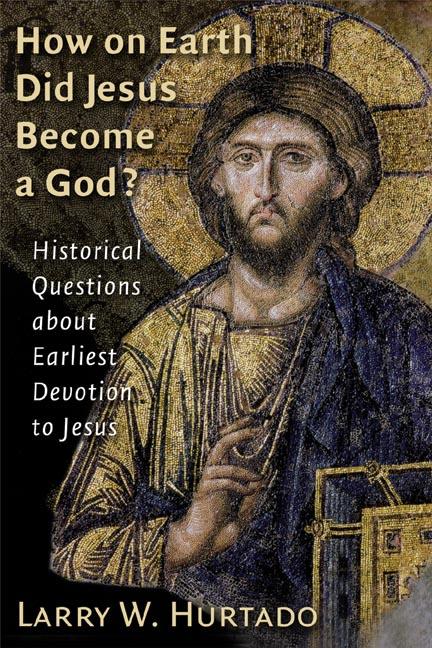
In his forthcoming book on early Christian Devotion, How on Earth Did Jesus Become a God? Larry Hurtado investigates the keen devotion to Jesus that emerged with surprising speed after his death. Reverence for Jesus among early Christians, notes Hurtado, included both grand claims about Jesus' significance and a pattern of devotional practices that effectively treated him as divine. Directed at readers across religious lines, this book argues that whatever one makes of such devotion to Jesus, the subject at least deserves serious historical consideration. Mapping out the lively current debate about Jesus for interested newcomers, Hurtado explains the evidence, issues, and positions at stake. His clear and learned treatment of such matters as persecution of Jesus worshipers and Christianity's development out of Judaism will also catch the interest of students and specialists.
The book has a useful chapter: To Live and Die for Jesus: Social and Political Consequences of Devotion to Jesus in Earliest Christianity. The chapter outlines several interesting features on early Christian practices and how these would have been perceived by the various social and political structures of the day. These include, Family Relations, Christians married to non-Christians, and Christian Slaves. What I found most interesting in this chapter, was his section on Family Relations. The following reflections are based on that chapter, which Dr. Hurtado was kind enough to let me read. However, one should not assume that all my conclusions or comments are necessarily his.
Although Hurtado does not argue that these stem from the historical Jesus, but just notes that they come from the Jesus-Tradition, I think a strong argument can be made for the authenticity of many sayings referring to the family and allegiance to Jesus. The first two sayings on family come from the supposed Quelle document, the hypothetical source for Matthew and Luke. Without detailing arguments here, I feel this refers to oral tradition and there are ways around the synoptic problem that do not require the "Q" hypothesis [which in my mind has become overly complex and unnecessary]. The Lukan parallel of our Matthean axiom has Semitic traces.[1]
Matt 10:34-39 “Do not think that I have come to bring peace to the earth; I have not come to bring peace, but a sword. For I have come to set a man against his father, and a daughter against her mother, and a daughter-in-law against her mother-in-law; and one’s foes will be members of one’s own household. Whoever adores father or mother more than me is not worthy of me; and whoever adores son or daughter more than me is not worthy of me; and whoever does not take up the cross and follow me is not worthy of me. Those who find their life will lose it, and those who lose their life for my sake will find it.
Luke 12:51-53 Do you think that I have come to bring peace to the earth? No, I tell you, but rather division! From now on five in one household will be divided, three against two and two against three; they will be divided: father against son and son against father, mother against daughter and daughter against mother, mother-in-law against her daughter-in-law and daughter-in-law against mother-in-law.”
Luke 14:25-27 Now large crowds were traveling with him; and he turned and said to them, “Whoever comes to me and does not hate father and mother, wife and children, brothers and sisters, yes, and even life itself, cannot be my disciple.
Jesus’ call to become a disciple involved an exclusivist socio-political and religious claim upon those who chose to embrace him as their king. One should not think [cf. Matt 5:17] that Jesus’ mission brings peace rather than a sword. However, one should also not imagine that this means that Jesus has the intention of a violent agenda. Jesus goes on to explain what he intends by contrasting peace and the sword. Jesus does not appear to be ignorant that his call to “repent and believe for the reign of YHWH is dawning” will incite a war of allegiances.
But Jesus is quick to highlight exactly how his team must work out and remain faithful to his agenda within this dawning battle of loyalties. In a societal milieu of traditional values and familial commitments Jesus’ mission and message will divide and separate those wanting to be faithful to him, and those wanting to hold onto several time honoured traditions. It will affect every sort of relationship, whether by blood or marriage. It will also affect various authority structures set within the household as Jesus claims superiority in all relationships. This will, inevitably cause both trouble and division.[2] Jesus’ followers are warned that they may have to choose between their commitment to him and their own family (Matt. 10:37-39; Luke 14:26-27). The reason is clear: the royal proclamation of the reign of YHWH and the summons to embrace and entrust Jesus as the king, cannot be adequately understood apart from careful attention being paid to the “extended household” (Gk oikos; Lat familia). In households, the pater familias [father] was the head of the household who held the authority and position of honour.[3] This is whole structure is being directly challenged by Jesus. Loyalty to Jesus must take precedence over any other familial relationship.
The reason being is clearly stated by Jesus, and he is unashamed to note this. Jesus as their true king must be worthy of more affection, adoration and allegiance than anyone or anything else. The christological implications of this claim now come to the fore as one considers the notion of idolatry and Torah. Torah has clearly laid out that one should honour familial relationships, especially the patriarchal head of the house. But Jesus’ kingdom announcement calls for a loyalty that transcends such boundaries. We would not have to incorporate much more data to substantiate the further claim that Jesus, in proclaiming the kingdom of God, was claiming to be YHWH’s anointed Messiah/King. And this is not difficult to imagine. Jesus certainly claimed more allegiance than just a prophet. The allegiance that Jesus claimed went beyond the prescriptions of Torah and thus alert us to the unparalleled authority claimed by Jesus.
For Gentiles a proper conversion to Jesus would have to involve a radical disassociation from their previous, traditional religious groups and practices. One cannot but suggest this as a plausible account of Jesus’ petition to follow him in his counter-empire mission of bringing the reign of YHWH into play.
In commenting on the Lukan pericope, Joel Green notes generally that:
As his present discourse, begun in 12:1, has already made clear, a decision to adopt his canons of faithfulness to God would require a deeply rooted and pervasive transformation of how one understands God and how one understands the transformation of the world purposed by this God. This would involved Jesus’ disciples in dispositions and forms of behaviour that could only be regarded as deviant within their kin groups. Earlier Jesus had been concerned to prepare his disciples for the persecution before the authorities that would result from identification with his mission (vv. 1-12); now he maintains that his ministry has as one of its consequences the deconstruction of convention family bonds.[4]
In our Matthean version Jesus specifically states that the issue is worship, i.e. who is worthy of more affection, adoration and allegiance. The division is ultimately about worth-ship. Who is worthy of this kind of allegiance and adoration? What is so significant about Jesus that loyalty to him should transcend traditional kinship groups? Why should they allow Jesus to invade their family structures with his announcement of the reign of YHWH? Who does Jesus think he is that he can claim this kind of loyalty, that should possibly only be given to YHWH or even the emperor?[5]
Jesus was inciting allegiance to in a society gone astray. Gone away into exile…
And then we have mention of the call to the cross. Again, the issue of worth-ship is at the fore here. If one does not follow Jesus’ command and call, one is simply not worthy. One has not considered the weight of the matter at hand, and who exactly is issuing this call. We must remind ourselves that the cross is the greatest symbol of foreign oppression and dictatorship. It categorically states that this is what happens to those who do not pledge allegiance to Rome and her emperor. But if Jesus’ challenge applies to family units, does it apply to the greater Roman family where the emperor is the great Father of the nation? The one who provides PAX and prosperity? Is there again, a subversive challenge to the greater familial loyalty of local inhabitants to the Emperor?
[1] See Witherington, The Christology of Jesus, pg. 121
[2] According to Davies and Allison, Matthew, II pg. 217 n.22 “When Jesus and his messengers are not received, there cannot but be conflict.”
[3] One must remember that the father exercised total legal control (potestas) over both his family and the enslaved members of his household. According to Roman law, this potestas even included the power over life and death.
[4] Green, The Gospel of Luke, pg. 509
[5] Or as Green, The Gospel of Luke, pg. 509 asks: “How could a ministry the effects of which include the dissolution of family ties be sanctioned by God?”

Scholars

Mark Goodacre has put us in his debt once again by updating his list of various scholars websites. Of special note must be M. M. Thompson who has a significant amount of course material available on her site.
The amount of helpful material on the gospels, Jesus, New Testament exegesis and background material is truly helpful! Although these present only notes and not full articles, all the right questions are being asked and some helpful hints provided. I remember reading Thompson's entry "Jesus and His God" in The Cambridge Companion to Jesus and thinking to myself, here is a helpful and erudite scholar who knows Jesus well. So check out the resources and learn something new...