Thursday, September 01, 2005

Sovereignty and Jesus

I am so thankful for posts like Ben Witherington's recent entry: But the Lord was not in the Wind. In further discussion in the comments, Ben makes these further remarks that are so helpful I must quote them at length!

The sovereignty of God is of course an important subject in the Bible, as my mentioning of Rom. 8 at the end of this blog ought to show. But it is a huge mistake to equate God's sovereignty with causation when it comes to a whole host of events. The issue is not whether God is almighty, but rather how does God exercise his sovereignty. The problem with John Piper and other scholars who read the Bible as if it were written by Augustine or Calvin rather than by early Jews, is that they do not understand how early Jews thought about these subjects, which involves allowing there to be more than one source of causation in the universe. The alternative is indeed to make God the author of what God in fact calls evil repeatedly in Scripture--- which is a huge besmirching of the character of God. It is equally problematic to make God's sovereignty the heremeneutical key by which then one tries to fit God's other attributes into a procrustean bed. For example God's love or God's desire that none should perish but all have everlasting life (see e.g. Jn. 3.16-17; 1 Tim. 2.6) do not fit the Augustinian understanding of sovereignty. And while we are at it, Ephes. 1.11 simply tells us that God is almighty to save. It is in no way a commentary on the cause of evil and tragedy in this world.
But perhaps the greatest failure of the Piper model of sovereignty is that it gets wrong the whole nature of God's love, which involves freedom not only on the part of God but also real freedom of response on the part of those he is wooing and loving. It is a case of "freely you have received, freely give". Love is not something that can be predetermined and still be love. Automata are not capable of love. And as 1 John reminds us in so many ways God is love. This I would suggest must affect the way we think about God's sovereignty or else we are actually Moslems, not Christians with a belief in pure fatalism, all things predetermined. The alternative to Augustinianism is not Deism-- it is rather a full orbed view of all of God's attributes including God's love. God is not the only actor in the universe whose will matters, and this is because God chose for it to be otherwise from before the foundations of the universe.
While some may have reservations about the theology of Open Theism, one must admit that Calvinism is bankrupt in it's notion that the God of scripture is ultimately the author of sin and/or evil. And where I'm sitting, Open Theisms attempt to deal with Freedom and Evil is a far better model [even though there are serious issues to be resolved] than that of determinism/Calvinism.
The most often quoted John 9 is helpless in the determinist case if we just pay attention to the text, the Greek text!
As he walked along, he saw a man blind from birth. His disciples asked him, "Rabbi, who sinned, this man or his parents, that he was born blind?" Jesus answered, "Neither this man nor his parents sinned; he was born blind so let God's works be revealed in him.
Jesus' response may be assumed to imply an agreement with those who wish to advance the view that even this man's blindness was determined by YHWH but the text doesn't actually support this premise. In the Greek text, the underlined section of this pericope is curiously absent. Therefore, in response to the primary question, Jesus simply says "Let the works of God be revealed." Translators include the words "he was born blind so that" because of a theological presupposition or they think it is implied in Jesus' answer to the disciples question. But presuppositions and assumptions don't carry much weight when they are being directly questioned and challenged. Grammatically, the passage does not require the insertion of extra bits.
Ergo, in response to the disciples question, Jesus responds by saying "Let God be Glorified". In essence, as per usual, they were asking the wrong question. What matters is seeing the work of God revealed, not debating who or what sin/agent caused the problem. If we do not allow the assumption that Jesus believed there was a divine reason for everything, the text is perfectly intelligible without the insertion. In response to evil or sickness, let's not seek to blame God, let's seek to glorify YHWH by asking Him to heal and restore. Jesus negates there question, he doesn't answer it. That's the theology of John 9.
Now obviously there are other issues that aren't resolved and that need to be addressed. But I think we best go back to the sources before assuming too much... Build on rock, not sand is what my master would say...

What is a Christian?

The Constructive Curmudgeon has an interesting post on What is a Christian? For some odd reason it sent my memory back to a quote that I fear many have missed in understanding just what a Christian is. Check it out...

Who were the strange people who called themselves “Christians”? what was the “kingdom” to which they claimed allegiance? And why did they stubbornly refuse to offer the usual, patriotic sacrifices to Augustus Caesar and, in so doing, willingly go to their deaths? These were the questions that most ancient Romans found hard to answer on the rare occasions when they came into direct contact with the unconventional sect of Christians, yet these subversive practices – the steadfast refusal to bow to false gods or pay homage to earthly powers – lay at the very heart of the early Christian faith. Emperor after emperor ordered campaigns of persecution against them. Roman authors branded them as “notoriously depraved” adherents of a “deadly superstition” that represented a direct threat to the moral majority of imperial Rome. Christians were hunted down in the slums and back alleys of Rome and other provincial cities. They were rounded up, beaten up, and condemned to execution for atheism and treason – that is, failing to participate in the state controlled cults of the gods of the Greco-Roman pantheon and abandoning honoured family values of pagan society.

On the surface, at least, the Christians appeared to be quite harmless. “The sum and substance of their fault or error,” observed the Roman jurist Pliny the Younger at the beginning of the second century C.E., after interrogating a number of suspected Christians, “Was that they were accustomed to meet on a fixed day before dawn and sing responsively a hymn to Christ as to a god, and to bind themselves by oath, not for any criminal purpose, but to abstain from fraud, theft and adultery and never make false promises or refuse to carry out a pledge when called upon to do so. When this ceremony was over, it was their custom to depart and to assemble again later to partake of food of an ordinary and innocent kind.”

This was only a part of the story. In close-knit communities and weekly assemblies, in which the Spirit moved people to burst into strange tongues and shouts of praise to Jesus the LORD and GOD the Father, early Christians rejected conventional career hopes, social ladders and civic honours. They fervently believed that the modern-day world of streets and market-places – the realm of tax collectors, loan agents, market inspectors, and imperial officials – could at any moment be rocked to its very foundations.

This was a Christianity without impressive churches, without authoritative clergy, without special outward trappings. Their hopes for a different kind of future for themselves and their children strengthened their faith in their impending redemption. Indeed, “Christianity” in its early decades was a network of a poor people and marginal communities in both cities and rural areas that a government, even a modern government, would have had a problem recognizing as a “religion” at all.

Early Christianity was in fact, a down to earth response to an oppressive ideology of earth power that had recently swept across continents, disrupted economies, and overturned ancient traditions. And this triumphant ideology of progress and development was expressed in many media: in the elegies of Latin poets, in the grandeur of Roman architecture, in Roman law-courts and statutes, in the technological triumphs of Roman engineering, and in the majestic, fatherly wave of every emperor’s hand. At the beginning of the second century C.E. – just at the time when Christianity was crystalising into a formalised, independent religion – a vast and growing publis was being taught to cooperate in the construction of a new global system of economics, culture, and civil administration, in which the gifure of the emperor had begun to take on the qualities of a single, supreme god. That was why the early Christians were viewed as so subversive.[1]

While the link provides us with a very theologically informed construction, I believe the quote provides us with a much needed injection of historical reality tht many theologians seem to have forgotten. Ad Fontes...
[1] Horsley R. and N. A. Silberman, The Message and the Kingdom, pg. 9-10

Devotion to Jesus

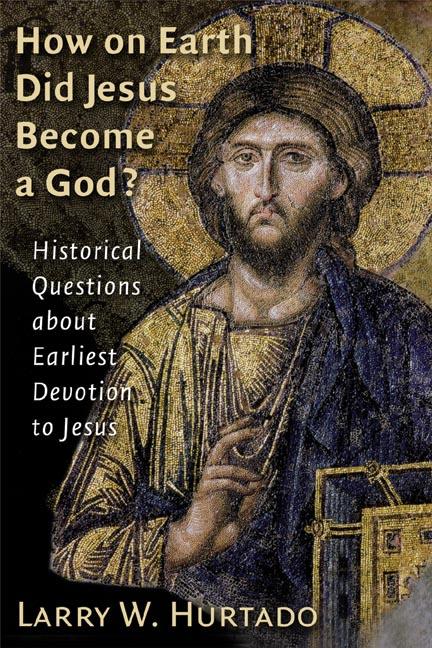
In his forthcoming book on early Christian Devotion, How on Earth Did Jesus Become a God? Larry Hurtado investigates the keen devotion to Jesus that emerged with surprising speed after his death. Reverence for Jesus among early Christians, notes Hurtado, included both grand claims about Jesus' significance and a pattern of devotional practices that effectively treated him as divine. Directed at readers across religious lines, this book argues that whatever one makes of such devotion to Jesus, the subject at least deserves serious historical consideration. Mapping out the lively current debate about Jesus for interested newcomers, Hurtado explains the evidence, issues, and positions at stake. His clear and learned treatment of such matters as persecution of Jesus worshipers and Christianity's development out of Judaism will also catch the interest of students and specialists.
The book has a useful chapter: To Live and Die for Jesus: Social and Political Consequences of Devotion to Jesus in Earliest Christianity. The chapter outlines several interesting features on early Christian practices and how these would have been perceived by the various social and political structures of the day. These include, Family Relations, Christians married to non-Christians, and Christian Slaves. What I found most interesting in this chapter, was his section on Family Relations. The following reflections are based on that chapter, which Dr. Hurtado was kind enough to let me read. However, one should not assume that all my conclusions or comments are necessarily his.
Although Hurtado does not argue that these stem from the historical Jesus, but just notes that they come from the Jesus-Tradition, I think a strong argument can be made for the authenticity of many sayings referring to the family and allegiance to Jesus. The first two sayings on family come from the supposed Quelle document, the hypothetical source for Matthew and Luke. Without detailing arguments here, I feel this refers to oral tradition and there are ways around the synoptic problem that do not require the "Q" hypothesis [which in my mind has become overly complex and unnecessary]. The Lukan parallel of our Matthean axiom has Semitic traces.[1]
Matt 10:34-39 “Do not think that I have come to bring peace to the earth; I have not come to bring peace, but a sword. For I have come to set a man against his father, and a daughter against her mother, and a daughter-in-law against her mother-in-law; and one’s foes will be members of one’s own household. Whoever adores father or mother more than me is not worthy of me; and whoever adores son or daughter more than me is not worthy of me; and whoever does not take up the cross and follow me is not worthy of me. Those who find their life will lose it, and those who lose their life for my sake will find it.
Luke 12:51-53 Do you think that I have come to bring peace to the earth? No, I tell you, but rather division! From now on five in one household will be divided, three against two and two against three; they will be divided: father against son and son against father, mother against daughter and daughter against mother, mother-in-law against her daughter-in-law and daughter-in-law against mother-in-law.”
Luke 14:25-27 Now large crowds were traveling with him; and he turned and said to them, “Whoever comes to me and does not hate father and mother, wife and children, brothers and sisters, yes, and even life itself, cannot be my disciple.
Jesus’ call to become a disciple involved an exclusivist socio-political and religious claim upon those who chose to embrace him as their king. One should not think [cf. Matt 5:17] that Jesus’ mission brings peace rather than a sword. However, one should also not imagine that this means that Jesus has the intention of a violent agenda. Jesus goes on to explain what he intends by contrasting peace and the sword. Jesus does not appear to be ignorant that his call to “repent and believe for the reign of YHWH is dawning” will incite a war of allegiances.
But Jesus is quick to highlight exactly how his team must work out and remain faithful to his agenda within this dawning battle of loyalties. In a societal milieu of traditional values and familial commitments Jesus’ mission and message will divide and separate those wanting to be faithful to him, and those wanting to hold onto several time honoured traditions. It will affect every sort of relationship, whether by blood or marriage. It will also affect various authority structures set within the household as Jesus claims superiority in all relationships. This will, inevitably cause both trouble and division.[2] Jesus’ followers are warned that they may have to choose between their commitment to him and their own family (Matt. 10:37-39; Luke 14:26-27). The reason is clear: the royal proclamation of the reign of YHWH and the summons to embrace and entrust Jesus as the king, cannot be adequately understood apart from careful attention being paid to the “extended household” (Gk oikos; Lat familia). In households, the pater familias [father] was the head of the household who held the authority and position of honour.[3] This is whole structure is being directly challenged by Jesus. Loyalty to Jesus must take precedence over any other familial relationship.
The reason being is clearly stated by Jesus, and he is unashamed to note this. Jesus as their true king must be worthy of more affection, adoration and allegiance than anyone or anything else. The christological implications of this claim now come to the fore as one considers the notion of idolatry and Torah. Torah has clearly laid out that one should honour familial relationships, especially the patriarchal head of the house. But Jesus’ kingdom announcement calls for a loyalty that transcends such boundaries. We would not have to incorporate much more data to substantiate the further claim that Jesus, in proclaiming the kingdom of God, was claiming to be YHWH’s anointed Messiah/King. And this is not difficult to imagine. Jesus certainly claimed more allegiance than just a prophet. The allegiance that Jesus claimed went beyond the prescriptions of Torah and thus alert us to the unparalleled authority claimed by Jesus.
For Gentiles a proper conversion to Jesus would have to involve a radical disassociation from their previous, traditional religious groups and practices. One cannot but suggest this as a plausible account of Jesus’ petition to follow him in his counter-empire mission of bringing the reign of YHWH into play.
In commenting on the Lukan pericope, Joel Green notes generally that:
As his present discourse, begun in 12:1, has already made clear, a decision to adopt his canons of faithfulness to God would require a deeply rooted and pervasive transformation of how one understands God and how one understands the transformation of the world purposed by this God. This would involved Jesus’ disciples in dispositions and forms of behaviour that could only be regarded as deviant within their kin groups. Earlier Jesus had been concerned to prepare his disciples for the persecution before the authorities that would result from identification with his mission (vv. 1-12); now he maintains that his ministry has as one of its consequences the deconstruction of convention family bonds.[4]
In our Matthean version Jesus specifically states that the issue is worship, i.e. who is worthy of more affection, adoration and allegiance. The division is ultimately about worth-ship. Who is worthy of this kind of allegiance and adoration? What is so significant about Jesus that loyalty to him should transcend traditional kinship groups? Why should they allow Jesus to invade their family structures with his announcement of the reign of YHWH? Who does Jesus think he is that he can claim this kind of loyalty, that should possibly only be given to YHWH or even the emperor?[5]
Jesus was inciting allegiance to in a society gone astray. Gone away into exile…
And then we have mention of the call to the cross. Again, the issue of worth-ship is at the fore here. If one does not follow Jesus’ command and call, one is simply not worthy. One has not considered the weight of the matter at hand, and who exactly is issuing this call. We must remind ourselves that the cross is the greatest symbol of foreign oppression and dictatorship. It categorically states that this is what happens to those who do not pledge allegiance to Rome and her emperor. But if Jesus’ challenge applies to family units, does it apply to the greater Roman family where the emperor is the great Father of the nation? The one who provides PAX and prosperity? Is there again, a subversive challenge to the greater familial loyalty of local inhabitants to the Emperor?
[1] See Witherington, The Christology of Jesus, pg. 121
[2] According to Davies and Allison, Matthew, II pg. 217 n.22 “When Jesus and his messengers are not received, there cannot but be conflict.”
[3] One must remember that the father exercised total legal control (potestas) over both his family and the enslaved members of his household. According to Roman law, this potestas even included the power over life and death.
[4] Green, The Gospel of Luke, pg. 509
[5] Or as Green, The Gospel of Luke, pg. 509 asks: “How could a ministry the effects of which include the dissolution of family ties be sanctioned by God?”

Scholars

Mark Goodacre has put us in his debt once again by updating his list of various scholars websites. Of special note must be M. M. Thompson who has a significant amount of course material available on her site.
The amount of helpful material on the gospels, Jesus, New Testament exegesis and background material is truly helpful! Although these present only notes and not full articles, all the right questions are being asked and some helpful hints provided. I remember reading Thompson's entry "Jesus and His God" in The Cambridge Companion to Jesus and thinking to myself, here is a helpful and erudite scholar who knows Jesus well. So check out the resources and learn something new...

Tuesday, August 30, 2005

Craig Evans

Check out Craig Evans excellent powerpoint presentations, and brief introductions to Jesus and the background of early Christianity/Judaism. These powerpoint presentations will aid as a good teaching resource that can be supplemented by your lecture notes.
I've just been reading through each of them on the quest, Jesus in Context, Burial traditions, Inscriptions, Papyri, Apocryphal gospels and even The Da Vinci Code. They provide brief snippets of information and great pictures to accompany the text. A very helpful presentation that may find its way into great use for my teaching! Thanks Dr. Evans!
Many will also be happy to hear that Evans fantastic book, NonCanonical Writings and the New Testament has been completely re:written and published as: Ancient Texts for New Testament Students. This will be a great help to students, and I have found the former edition invaluable. I would also suggest that Evans book, Jesus and His Contemporaries ranks as one of the best books on the historical Jesus ever written. So check it out!

Eucharistio?

Is this how the new Pope will celebrate the Eucharist? I wonder what the apostle Paul, or even Jesus would say...

Justification and Galatians - random thoughts

Justification and Galatians - random thoughts...
There is so much discussion about "justification" and "righteousness" going around that I am weary of wading into these waters for fear of getting lost in other matters besides the gospels. But I do like to read around and there is a wonderful blog about Leon Morris and the NPP that has left me thinking...

I pledge allegiance to no particular historical theological framework [well, maybe the Apostles Creed but that's about it], which is both helpful and lonely at times, but when it comes to justification I don't see the Reformers point in criticizing Wright. There have always been two important paragraphs from Wright that have helped me understand a biblical theology of Justification. I quote them at length to avoid misunderstanding:

The resurrection provides the basis for the true definition of God’s people. God has vindicated Jesus as Messiah, and has thereby declared that those who belong to him, who in the Heb. idiom are ‘in Christ’ (cf. 2 Sa. 19:43–20:2), are the true Israel. The marks of new covenant membership are the signs of the Spirit’s work, i.e. faith in Jesus as Lord, belief in his resurrection, and baptism as the mark of entry into the historical people of God (Rom. 10:9–10; Col. 2:11–12). ‘Justification’ is thus God’s declaration in the present that someone is within the covenant, a declaration made not on the basis of the attempt to keep the Jewish law but on the basis of faith: because faith in Jesus is the evidence that God has, by his Spirit, begun a new work in a human life which he will surely bring to completion (Rom. 5:1–5; 8:31–39; Phil. 1:6; 1 Thes. 1:4–10). The present divine verdict therefore correctly anticipates that which will be issued on the last day on the basis of the entire life of the Christian (Rom. 2:5–11; 14:10–12; 2 Cor. 5:10). This double verdict is thus based on two things—the death and resurrection of Jesus and the work of the Spirit: Christ and the Spirit together achieve ‘that which the law could not do’ (Rom. 8:1–4). ‘Justification’ thus redefines the people of God, and opens that people to all who believe, whatever their racial or moral background.

In this lecture on Coming Home to St. Paul, Wright notes that:

The Paul of Romans is thus a deeply Jewish thinker, rethinking his Jewish categories around his belief that the crucified and risen Jesus is Israel’s representative Messiah. Within this scheme of thought, the key focal points stand out. Jesus’ obedient death is the central covenant action, revealing God’s love and grace in decisive and climactic action, dealing with sin by condemning it in his flesh (8.3). Justification by faith is the juridical declaration in the present time which anticipates the verdict of the last day: faith that Jesus is Lord, and that God raised him from the dead, is the result of the Spirit’s work through the gospel – and what God has thus begun, he will certainly complete. Justification is not merely lawcourt language, however; if it were, it would be isolated from the life of the church and from Christian morality. Justification is also covenant language, as in Romans 4 (a sustained exposition of Genesis 15, where God establishes his covenant with Abraham), and has to do precisely with God’s setting up of the single family, consisting of Jews and Gentiles together, characterised by faith rather than by possession or keeping of Torah.

In these two striking paragraphs we see the tenses of justification, which many have neglected and/or ignored. But despite that, I am perplexed by many statements that want to make justification either vertical or horizontal, because for Paul it was clearly both.

There is just no way to get around Dunn's argument that Galatians 2 is dealing with justification horizontal, not vertical. Now I realise that in Galatians 3 the vertical justification is brought into the argument, but Gal 2, especially vss. 15-21 are bound up with Gal 2:11-14 which are about horizontal justification.

The problem that Paul addresses in his letter to the Churches of Galatia is multifaceted and complex but can be located within reach of one key word: “faithfulness”. As we shall soon see, there was a major problem with who and what to be faithful to. Should the Galatian Christians be faithful to Paul and the gospel that he preached to them? Or should they be faithful to the Mosaic Law, as Jews had done for centuries past? Is faithfulness to Jesus enough, or does one also need to be faithful to “the works of Torah”? Has the “faithfulness of Jesus” transformed faithfulness to the “works of Torah”? If Jesus’ faithfulness has transformed the situation, how has it done so and what are the consequences? Essentially, the issue is tied up with “covenantal nomism”. But before we get to this new concept, we must discuss just “who” is causing the problems as this will help us decide “what” the problem is. We must also set the scene first by noting a few important details about Paul and Galatians.
To set the scene, and our reconstruction of the problem, we must know a few details about Paul and his congregations. The first thing to note is that the polemic of Galatians is all we have in our reconstruction. While Acts and Paul’s other letters will shed light on aspects of Paul’s thinking and life, we have no other such documents that will do this for the church and situation of the Galatians.[1]
Following a southern Galatian hypothesis, it appears that this is one of the very first times that the issue of covenantal nomism is addressed. The letter is probably to be dated around 49CE, before the Jerusalem Council. It could possibly even be a major reason for calling the Jerusalem council together. Perhaps there hadn’t been a major verdict such as this in early Christianity before this eruption between Cephas and Paul, and between Paul and the “faction from James”. We know that Paul founded the churches of Galatia during one of his missionary journeys, after the meeting mentioned in Gal. 2:1-10. We know that Paul had preached to them and left them “running well” (5:7). Somehow, after a while, Paul got word that his churches in Galatia were not doing to well. They had been infected with “another gospel” from an unidentified group, who were “from James” (2:12).[2] But who was this faction?
The identity of these so-called “missionaries”[3] is unknown to us, and possibly even unknown to Paul. The reason we posit that they are unknown to even Paul, is because Paul questions “Who has bewitched you?” (3:1) and “who prevented you from obeying the truth?” (5:7). Paul also gives a warning, “whoever it is that is confusing you will pay the penalty.” (5:10). Thus, it seems Paul had either a) not met them or b) did not know much about them. We know that they saw themselves as followers of Jesus, the Messiah (4:12). However, they were also very concerned with matters of the law and Jewish identity (2:3-6 & 4:9-10). Thus, it seems probable that they were Messianic Jews.
Scholars have suggested very different views as to what the mission and message of these Missionaries was. Despite the speculative nature of this exercise, there seems to be a few elements about which we may have some confidence: A) These missionaries were very concerned with being faithful to the law, and thus the covenant set up between Abraham and God, and nuanced by Moses in the Torah. B) External obedience to the “works of the law” was a pivotal part of their message and praxis in maintaining the distinctly ‘Jewish’ identity. With this in mind, Dunn concludes:
The letter makes clearest and fullest sense if we see it as a response to a challenge from Christian-Jewish missionaries who had come to Galatia to improve or correct Paul’s understanding of the gospel and to ‘complete’ his converts by integrating them fully into the heirs of Abraham through circumcision and by thus bringing them ‘under the law’.[4]
The problem thus comes directly into focus as Paul states his Propositio (Gal 2:15-21):
We are Jews ourselves, by birth, and not Gentile sinners; nevertheless we know that a person is not justified by the works of Torah but through the faithfulness of Jesus, the Messiah. And we have become faithful to the Messiah Jesus, so that we might be justified by the faithfulness of the Messiah, and not by doing the works of Torah, because ‘no one will be justified by the works of Torah’. - But if, in our effort to be justified in the Messiah, we ourselves have been found to be sinners, is the Messiah then a servant of sin? Absolutely not! But if I build up again the very things that I once destroyed, then I demonstrate that I am a transgressor. - Because through the law I died to the law, so that I might live to God. I have been crucified with the Messiah; and it is no longer I who live, but it is the Messiah who lives in me. And the life I now live in the flesh I live by the faithfulness of the Son of God, who loved me and gave himself for me. I do not nullify the grace of God; for if covenant membership comes through the Torah, then the Messiah died in vain.[5]
Despite the history of interpretation and tradition surrounding this pericope, there is still much confusion and debate.[6] The pivotal question that must remain in our minds as we grapple with this passage is, “what makes most historical sense within the argument that Paul presents to the Galatians?”[7]
In verse 15 Paul starts his section with “we”. The importance of this word cannot be overemphasized. It forms a direct connection[8] with the preceding section that outlines the incident in Antioch between Paul and Peter.[9] In the section 2:1-10, Paul has noted that both Peter and himself were entrusted with the ‘gospel’. Paul for the Gentiles and Peter for the Jews. We also have the incident of Titus, ‘not being compelled to be circumcised’.[10] The implication is that Titus was not asked to be circumcised by the Jerusalem leadership.[11] But what does this have to do with the issue at Galatia? It is our contention that Paul once again faces the same issue that he faced with Cephas.
Peter, while not sanctioning circumcision for the Gentiles, nevertheless felt compelled to obey other “works of Torah” such as food laws[12] and possibly festival observances (cf. 4:10).[13] For Paul, this was unacceptable. No “works of Torah” were required in being part of the true people of God.[14] For this reason, Witherington writes:
The issue raised in the propositio is – What should the role of the Mosaic Law be in the life of a Christian believer, whether Gentile or Jew, and as a subset of that question, should the Galatians submit to circumcision and the various other boundary-marking rituals of Judaism? Lying beneath all of this is the question – Who are the people of GOD, and what constitutes them as such?[15]
You see, the Jewish faction had persuaded Peter, and ‘even Barnabas’, that they should revert back to their Jewish praxis based on their observances of Torah. The Gentiles were not doing the “works of the Torah” which was required for full/complete membership in the people of YHWH and thus were excluded from table-fellowship. According to Paul, this was both a misunderstanding of the Gospel and inconsistent too. They seemed to have held that to be faithful to YHWH meant being faithful both to Jesus and the “works of Torah”. These two were the ‘identity markers’ of the people of YHWH. Being faithful to these two elements showed that one was a member of the people of God, it showed that one was ‘justified’. However, Paul’s contention is that justification came through faithfulness to Jesus, because Jesus had been faithful to them (2:16).
Wright defines justification as:
Justification is the recognition and declaration by God that those who are thus called and believing are in fact his people, the single family promised to Abraham, that as the new covenant people their sins are forgiven, and that since they have already died and been raised with the Messiah, they are assured of final bodily resurrection at the last.[16]
The only requirement for full membership in the people of God, according to Paul, was loyalty[17] towards Jesus. This is the crux of the issue. Verse 16 is directly concerned with the issue of “covenantal nomism”.[18] The corollary of this is that loyalty towards Jesus does away with any need for being faithful to the ‘works of Torah. It renders their purpose invalid. As Dunn rightly comments:
If we have been accepted by God on the basis of faith, then it is on the basis faith that we are acceptable, and not on the basis of works. Perhaps for the first time, in this verse faith in Jesus Messiah begins to emerge not simply as a narrower definition of the elect of God. From being one identity marker for the Jewish Christian alongside the other identity markers (circumcision, food laws, Sabbath), faith in Jesus as Christ becomes the primary identity maker which renders the others superfluous.[19]
This in turn leads to Paul’s anticipative comments on the problem with such ‘freedom’ from covenantal obligations. Without the boundaries of the ‘works of Torah, will the Galatians merely become Gentile sinners?[20] “Absolutely Not!”, says Paul. Our freedom in Messiah is freedom from that slavery to the “law of Messiah” (6:2). Just because one has given up those boundary-markers as signs of being part of the people of YHWH, does not therefore necessitate that they will not live distinct lives as the marked and chosen people of God. On the contrary says Paul, their lives will be evident by “faith working through love” (5:6) and their praxis stained by the boundary-markers of the ‘life’ and ‘fruit’ of the Spirit (5:16, 22). This is the whole point of Paul’s comment in 2:17, which he later unpacks and defends in chapter 5 and 6 of this letter. We are free says Paul, free to love and follow Jesus in the power and presence of the Spirit, who will lead and guide us as the people of God. This is where the distinctive pivsti"` Cristou` debate comes to the fore. The faithfulness of Jesus to God becomes the new paradigm by which those who are faithful to Jesus, shall live. 2:16 shows that Jesus has been faithful and 2:20 is our response: “I no longer live, but the Messiah lives in me.” This phrase must refer to the intimate relationship one has with Jesus and also the life of faithfulness one lives by following the clear example that Jesus is. This is what it means to be found and to “live” in the Messiah (2:19-20). If the Galatians are not faithful to God, then there are huge implications.[21] Finally, Paul wishes to charge, both Peter and the missionaries, actions with obstructing the very grace of God that they are trying to maintain. This is how the grace of God has been revealed, through the faithfulness of Jesus. To still hold to covenantal nomism is to invalidate what Jesus has done. “We are a new creation, behold the old is gone, the new is come.”
[1] What Longenecker and others have called “mirror reading”. Cf. R. Longenecker, Galatians [Grand Rapids: Nelson, 1990], pg. Lxxxix. Our hypotheses will always be, therefore, somewhat incomplete due to lack of evidence.
[2] I am troubled by this phrase. Does this mean that they had a) broken away from James; b) were sent out by James; c) had misunderstood James’ commission or that d) we are talking about someone different? D. A. Carson has proposed that the faction, and group from James are different groups but this merely begs questions.
[3] The term “Missionaries” is from J. D. G. Dunn, The Epistle to the Galatians [London: Hendrickson, 1993], pg. 11 and R. B. Hays, The Letter to the Galatians [NIB 11; Nashville: Abingdon, 2000] pg. 185
[4] Dunn, The Epistle to the Galatians, pg. 11
[5] This is my translation of Galatians 2:15-21. The word “justified” is peculiar and rather difficult to translate. Assuming a ‘new perspective’ position, I wonder whether it would be fair to translate the term as: ‘faithful to the covenant’ or even ‘obedient to the covenant’. This is of course interpretive, but which translation isn’t? Therefore, our statement would read: “a person is not faithful to the covenant by the works of Torah but through the faithfulness of Jesus.” The Dikaiow word group seems to be a concept word group, one which defies straight lexical translation in either form.
[6] It shall be evident that we quickly parts ways with the interpretations given by F. F. Bruce, The Epistle to the Galatians [Exeter: Paternoster, 1982] pg. 136-147 and R. Y. K. Fung The Epistle to the Galatians [Grand Rapids: Eerdmans, 1988] pg. 112-127. The major reason for this being, we see Galatians as an intra-communal debate about praxis and not with Jewish outsiders about legalism.
[7] Wright, The Letter to the Galatians, pg. 207 notes that “the basic task of exegesis is to address, as a whole and in parts, the historical questions: What was the author saying to the readers; and why? The questions ultimately demand an answer at the broadest level in the form of a hypothesis to be tested against the verse by verse details. One may, perhaps, allow the author some imprecision, particularly in such a heated composition, but if even a small number of details do not fit the hypothesis, it will be called into question.”
[8] The NRSV footnotes that some interpreters see this as a continuing quotation from the previous pericope.
[9] I shall not entertain the possibility, noted by B. Ehrman, The New Testament [Oxford: Oxford University, 1997], pg. 288; that Cephas and Peter are possibly two different people that Paul is talking about. Scholarship has not found this tradition or interpretation persuasive.
[10] cf. Dunn, The Epistle to the Galatians, pg. 96 with references.
[11] Dunn, The Epistle to the Galatians, pg. 96
[12] J. D. G. Dunn, Jesus, Paul and the Law [Louisville: Westminster/John Knox Press, 1990], pg. 193 writes: “Without question the devout Jew of Paul’s day would regard observance of the laws on clean and unclean foods as a basic expression of covenant faithfulness… The maintenance of ritual purity, particularly the ritual purity of the mean table, was a primary concern and major occupation.”
[13] Does 4:10 highlight a similar issue faced at Antioch or is it peculiar to the situation in Galatia?
[14] cf. N. T. Wright, The Climax of the Covenant [Minneapolis: Fortress, 1992], pg. 154 who states: “Christian Jews enter the renewed Abrahamic covenant not by works of Torah, but by faith, just as Christian Gentiles do.” This seems to be the point of 3:28.
[15] B. Witherington, Grace in Galatia [Cambridge: Eerdmans, 1998] pg. 172
[16] N. T. Wright, “The Letter to the Galatians: Exegesis and Theology” in Between Two Horizons: Spanning New Testament Studies and Systematic Theology Eds. J. B. Green & M. Turner [Cambridge: Eerdmans, 1999], pg. 235
[17] The synonyms for pistis", are: faithfulness, trust, reliability, faith and belief. Loyalty and allegiance are synonyms for faithfulness, but seem to capture the essence of the Greek words better than the usual translations. cf. “pistis” in Bauer, Walter, Gingrich, F. Wilbur, and Danker, Frederick W. A Greek-English Lexicon of the New Testament and Other Early Christian Literature. [Chicago: University of Chicago Press, 1979], [Online] Available: Logos Library System; and Louw, J. P. and Nida, E. A. Greek-English Lexicon of the New Testament based on Semantic Domains. [New York: United Bible Societies, 1988, 1989], [Online] Available: Logos Library System.
[18] E. P. Sanders, Paul and Palestinian Judaism, pg. 75, 420: “Covenantal nomism is the view that one’s place in God’s plan is established on the basis of the covenant and that the covenant requires as the proper response of man his obedience to its commandments, while providing means of atonement for transgression… Obedience maintains one’s position in the covenant, but it does not earn God’s grace as such.” Quoted in Dunn, Jesus, Paul and the Law, pg. 186
[19] Dunn, Jesus, Paul and the Law, pg. 196
[20] We must understand that the boundary-markers of covenantal nomism gave the Jewish people their identity. Without them, would they merely assimilate into pagan culture? This seems to be the inference that the missionaries might have drawn. Paul is adamant that our identity is grounded and founded in the Messiah (cf. Gal. 2:19-20).
[21] As far as the Jewish-Christians were concerned, this could be detrimental. As Betz notes: “outside of the Torah covenant, there is no salvation.” Betz, Galatians [Minneapolis: Fortress, 1979], pg. 115
[22] Betz posits the interesting notion of whether obeying the law is such a bad thing, as long as one wasn’t trying to “justify” oneself by it. See Betz, Galatians, pg. 117
[23] Wright, The Letter to the Galatians, pg. 224
[24] Wright, The Letter to the Galatians, pg. 224-26 makes some strong comments about distinctions which have been rendered artificial by the cross of the Messiah.

Friday, August 26, 2005

Veritas Forum

The Veritas Forum has loads of audio files by respected scholars on Jesus.
The topics discussed are many and varied and they include lectures by philosophers like Dallas Willard, Peter Kreeft, W. L. Craig, Vinoth Ramachandra, preachers like John Stott, Ravi Zacharias, and biblical scholars such as Grant Osbourne, N.T. Wright and Craig Blomberg.
While these appear to be from an evangelical perspective, they look to be quite interesting. The forum has links to many other lectures on various topics from a Christian perspective that appear to be helpful for those interested. For those who don't have access to hearing live lectures by some of these scholars it's an added bonus to be able to download them and listen to them whenever you want to. They're all now in my audio library for use at my request.
How nice!

Tuesday, August 23, 2005

a clip of thought...

A few weeks ago a friend, Brett Fish shared this story with our students. I've been sick in bed for the past week - unable to do anything, but this story kept coming back to me. It's a sober reminder of how conviction must feel...
Then Granny said, ‘It’s no good you trying to make me believe in Om, though.’
‘Om forbid that I should try, Mistress Weatherwax. I haven’t even given you a pamphlet, have I?’
‘No, but you’re trying to make me think, “Oo, what a nice young man, his god must be something special if nice young men like him helps old ladies like me,” aren’t you?’
‘No.’
‘Really? Well, it’s no working. People you can believe in, sometimes, but not gods. And I’ll tell you this, Mister Oats…’
He sighed. ‘Yes?’
She turned to face him, suddenly alive. ‘It’d be as well for you if I didn’t believe,’ she said, prodding him with a sharp finger. ‘This Om… anyone seen him?'
‘It is said three thousand people witnessed his manifestation at the Great Temple when he made the Covenant with the prophet Brutha and saved him from death by torture on the iron turtle –‘
‘But I bet that now they’re arguing about what they actually saw, eh?’
‘Well, indeed, yes, there are many opinions–’

‘Right, Right. That’s people for you. Now if I’d seen him, really there, really alive, it’d be in me like a fever. If I though there was some god who really did care two hoots about people, who watched ‘em like a father and cared for ‘em like a mother… well, you wouldn’t catch me saying’ things like “There are two sides to every question,” and “we must respect other people’s beliefs.” You wouldn’t find me just being generally nice in the hope that it’d all turn out right in the end, not if that flame was burning in me like an unforgiven’ sword. And did I say burnin’, Mister Oats, ‘cos that’s what it’d be. You say that you people don’t burn folk and sacrifice people any more, but that’s what true faith would mean, y’see? Sacrificin’ your own life, one day at a time, to the flame, declarin’ the truth of it, working’ for it, breathin’ the soul of it. That’s religion. Anything else is just … is just bein’ nice. And a way of keepin’ in touch with the neighbours.’
She relaxed slightly, and wont on in a quieter voice: ‘Anyway, that’s what I’d be, if I really believed. And don’t think that’s fashionable right now, ‘cos it seems that if you sees evil now you have to wring your hands and say, “Oh deary me, we must debate this.” That’s my two penn’orth, Mister Oats. You be happy to let things lie. Don’t chase faith, ‘cos you’ll never catch it.’ She added, almost as an aside, ‘But perhaps you can live faithfully.’
Her teeth chattered as a gust of icy wind flapped her wet dress around her legs. ‘You got another book of holy words on you?’ she added.
‘No,’ said Oats, still shocked. He thought: my god, if she ever finds a religion, what would come out of these mountains and sweep across the plains? My god… I just said, ‘My god’…
Jesus said: Seek first the Kingdom of God, and all else will be added unto you.

Tuesday, August 16, 2005

quote of the day...

Jesus is the millenarian prophet of judgment, the embodiment of the divine discontent that rolls through all things. He sees those who go about in long robes and have the best seats in the synagogues while they lock others out of the kingdom. He sees a rich man clothed in purple and fine linen who feasts sumptuously every day while at his gate is famished Lazarus, whose only friends are the dogs who lick his sores. He sees people who are gorgeously apparelled, who live in luxury in royal palaces, and who entertain themselves with the severed head of Elijah come again. What Nietzsche aptly if disparagingly called a “slave morality of chastity, selfishness, and absolute obedience” permits Jesus to see the truth about those who will power instead of justice. They are an evil generation, the blasphemers of the Holy Spirit, the first who will become last. Jesus knows that God promised never again to destroy the world through a flood, but he makes ready for the flood of the end-time anyway. He prepares for the baptism with which he will be baptized.

Jesus is the millenarian prophet of consolation and hope who comforts those who mourn. He sees the poor, the hungry, and the reviled, and he proclaims that the last will be first. He makes the best of a bad situation: things are not what they seem to be; everything will be OK. He declares, against all the evidence, that the oppressed and the destitute are no miserable but blessed. They will have treasure in heaven. They will be rewarded at the resurrection of the just.

Jesus is the millenarian prophet whose realism is so great that it must abandon the world, the lust of the eyes and the pride of life. He knows that we, being evil, cannot fix things, that the wall cannot climb itself. How bad is it? What is the world really like? God’s envoy is reviled as in league with Beelzebul, and the city of the great king kills the prophets and stones those sent to it. Clearly all has gone irredeemably wrong. The kingdom of God suffers violence.